


Views: 0 Author: Site Editor Publish Time: 2026-07-14 Origin: Site


Cold rooms can lose performance even when panels look intact. Small foam defects may raise heat gain, stress refrigeration equipment, and shorten panel life. Polyester polyols help rigid PUR and PIR foams resist these problems. This article explains how they improve thermal control, structural stability, processing, and long-term insulation reliability.
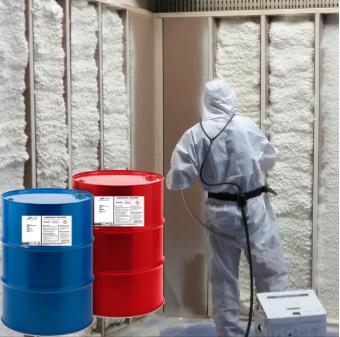
● Polyester polyols help create rigid foam structures suited to insulated panels, refrigeration equipment, cold rooms, and refrigerated transport systems.
● Their molecular structure can support fine, uniform, closed cells. These cells slow heat movement and help the foam maintain consistent insulation across large panels.
● Aromatic polyester polyols can improve foam rigidity, compressive strength, heat resistance, metal adhesion, and dimensional stability.
● Good compatibility with pentane blowing agents supports stable mixing, smooth foam flow, uniform cavity filling, and controlled cell formation.
● Polyester polyols work in both polyurethane and polyisocyanurate insulation. PIR systems often use them when stronger fire and heat performance is required.
● They do not determine performance alone. Isocyanates, catalysts, surfactants, blowing agents, moisture control, panel design, and production settings also affect the finished insulation.
Heat always moves toward a colder space. Cold room walls, ceilings, floors, and doors must slow this movement. When insulation has weak cells, uneven density, or hidden voids, more heat enters the storage area.
The refrigeration system must then run longer. This can raise operating costs and make temperature control less stable. A suitable rigid foam system reduces this unwanted heat gain across the full panel surface.
Cold storage panels face more than temperature differences. They also experience handling loads, equipment vibration, pressure changes, and repeated cooling cycles.
The foam core must keep its thickness and shape. Shrinkage may pull the foam away from metal facers. Expansion may place stress on joints. Compression damage can create thinner areas where heat passes more easily.
Moisture can enter through damaged facers, open joints, poor seals, or condensation points. It may weaken bonds and reduce long-term panel reliability.
Foam chemistry helps, but it cannot replace correct installation. Vapor barriers, sealed joints, suitable facers, and controlled site conditions remain essential. Polyester-based systems also need careful moisture management during storage and processing.
Polyester polyols react with isocyanates to form the polymer network inside rigid foam. Their structure can help produce small and stable cells when the full formulation is balanced.
Closed cells trap low-conductivity gases inside the foam. They limit air movement and slow heat transfer. Uniform cells also reduce weak zones, which may otherwise cause local shrinkage or uneven insulation.
Thermal conductivity shows how easily heat passes through a material. A lower value usually means better insulation at the same thickness.
Polyester polyols influence the foam matrix, cell size, density, and compatibility between formulation components. These factors affect heat movement through the finished foam. However, the final value also depends on the blowing gas, surfactant, foam density, cell closure, and production process.
Good formulation control matters more than one isolated raw-material property.
Dimensional stability describes how well foam keeps its original size. It is important during production, storage, installation, and cold room operation.
Unstable foam may shrink after curing. It can also expand during temperature exposure. Either problem may distort the panel, weaken joints, or separate the foam from its facer.
Aromatic polyester polyols can support a rigid, crosslinked structure. This helps panels resist shape changes during low-temperature service and repeated thermal cycling.
Cold storage foam must resist pressure without losing thickness. This is especially important in floor panels, large wall panels, doors, and transported structures.
Polyester polyols can support high rigidity and compressive strength. A stronger foam core helps the sandwich panel act as one structural unit. It also reduces deformation during demolding, stacking, transport, and installation.
However, greater rigidity is not always better. Excessive crosslinking may make foam brittle. Formulators must balance strength, adhesion, and toughness.
Many cold storage panels use steel or aluminum facers. The foam must bond evenly to these surfaces.
Strong adhesion helps transfer loads through the panel. It also limits delamination and surface distortion. Poor bonding may leave gaps, reduce structural strength, and create paths for moisture or heat.
Polyester polyols are often selected for their adhesion to metal facings.
Blowing agents create the cells inside rigid foam. Pentane systems are widely used for insulated panels and appliance insulation.
The polyester polyol must mix well with the blowing agent. Poor compatibility may cause separation, unstable foaming, large cells, or uneven density. Good compatibility supports a stable blend and smoother foam flow.
Rigid polyurethane foam offers insulation, strength, and practical processing. It is used in cold room panels, refrigeration doors, equipment housings, and appliance cavities.
Polyester polyols may form part of the polyol blend. They can improve rigidity, adhesion, chemical resistance, and heat performance. Polyether polyols may also be added to improve processing or moisture resistance.
The best blend depends on the production line and panel requirements.
Polyisocyanurate foam uses a higher isocyanate index than standard PUR foam. This creates isocyanurate structures that can improve heat resistance, char formation, and fire performance.
Aromatic polyester polyols are well suited to these systems. They help provide rigidity, dimensional control, and adhesion. This combination is useful for insulated metal panels used in cold warehouses and industrial refrigeration buildings.
PUR may offer easier processing and a useful balance of cost and insulation. PIR may be selected when the project has stricter heat or fire requirements.
Neither system is automatically correct for every cold room. Buyers should consider panel thickness, operating temperature, fire targets, joint design, facer type, production speed, and local building requirements.
A finished-panel test gives more useful information than the foam name alone.
Hydroxyl value affects how a polyol reacts with isocyanate. It influences reaction speed, crosslink density, rigidity, and curing behavior.
A higher value does not always provide better insulation. It may increase hardness, but it can also change viscosity, brittleness, and processing time. The correct range depends on the selected PUR or PIR system.
Viscosity affects pumping, metering, mixing, and cavity filling. Material that is too thick may be difficult to process. Material that flows poorly may leave voids inside large panels.
Low viscosity is not always ideal either. The formulation still needs controlled rise and stable cell formation. Processing temperature should remain consistent because temperature can greatly change viscosity.
Water reacts with isocyanates and creates carbon dioxide. A controlled amount may be part of the blowing system. Unplanned moisture can cause unstable reactions, excess gas, voids, or uneven density.
Acid value may affect catalysts and reaction timing. Both values should remain within the approved formulation limits. Batch certificates should be compared with actual incoming test results.
Polyester polyols cannot produce good insulation alone. Catalysts control reaction timing. Surfactants stabilize cells. Blowing agents create the cellular structure. Isocyanates form the polymer network.
A small change in one component may affect foam rise, curing, adhesion, density, and thermal performance. Each raw-material change should therefore be tested as part of the full formulation.
Note: Never approve a new polyol only because its hydroxyl value matches the current material.
Large wall and ceiling panels need even foam distribution. Good flow helps the mixture reach corners and edges before it cures.
Uniform density improves thermal consistency across the panel. Strong adhesion also keeps the metal skins and foam core connected. These properties support flatter surfaces and more stable panel joints.
Cold room doors open often and experience regular impact. Their foam cores must remain rigid without becoming excessively brittle.
Dimensional stability helps the door maintain its shape. This supports gasket contact and reduces the risk of warm-air leakage. The foam still requires a suitable frame, hinge system, and perimeter seal.
Refrigerated trucks, containers, freezers, and cabinets face vibration and changing outdoor temperatures. Their insulation must combine low weight, strength, and stable thermal performance.
Polyester-polyol-based rigid foam can support these needs. It helps maintain panel shape during movement while reducing heat transfer through the enclosure.
The materials offer different strengths. Many cold storage systems use blends to reach the required balance.
Selection factor | Polyester polyols | Polyether polyols |
Mechanical rigidity | Often higher | Usually more flexible |
Metal adhesion | Often stronger | Depends on formulation |
Heat and fire performance | Strong in aromatic PIR systems | Often needs additional support |
Hydrolysis resistance | Requires careful moisture control | Generally stronger |
Processing viscosity | Often higher | Often lower |
Best use | Structural panels and PIR systems | Moist or processing-sensitive systems |
Polyester polyols are valuable when a panel requires strong adhesion, high rigidity, compression resistance, and stable heat performance.
Their aromatic content also supports PIR chemistry. This makes them useful for structural insulation boards and metal-faced panels. They may also improve resistance to oils, chemicals, or demanding industrial conditions.
Polyether polyols often provide lower viscosity and better hydrolysis resistance. These features can help in humid environments or fast production systems.
They may also provide greater flexibility at low temperatures. A polyester-only formulation is therefore not always the best choice for every freezer or cold room.
A blended system can combine polyester strength with polyether processing and moisture resistance.
The ratio should be based on finished foam performance. Important tests include thermal conductivity, dimensional stability, adhesion, compression, density, and low-temperature aging.
The blend should also remain stable during storage and daily production.
Begin with the finished panel requirements. List the target density, thermal conductivity, compressive strength, dimensional stability, adhesion, and fire performance.
Also define the service temperature and panel application. A cold room wall may need different properties from a floor, door, vehicle panel, or freezer cabinet.
Check compatibility with the selected isocyanate, catalyst package, surfactant, flame retardant, and blowing agent.
A suitable polyester polyol should remain stable in the complete polyol blend. It should also support the required cream time, gel time, rise time, flow distance, and curing speed.
Compare hydroxyl value, viscosity, water content, acid value, appearance, and storage requirements.
Do not review only the average value. Ask about accepted variation between batches. A narrow and controlled range helps production teams maintain stable machine settings and foam quality.
Laboratory cup tests provide useful early information. They cannot replace panel trials.
Produce panels under normal line conditions. Check their edges, center density, adhesion, surface flatness, cell structure, compression, and dimensional change. Thermal testing should occur after the foam reaches its specified conditioning age.
Tip: Approve the material only after both laboratory foam and full-size panels meet the target specification.
Xinfa provides polyester polyols for rigid foam, PUR and PIR panels, pentane systems, and cold-chain insulation. They support thermal control, structural strength, stable cells, and reliable panel production. Xinfa also offers formulation customization, quality control, stable supply, and technical support. These services help manufacturers match raw materials to real production and insulation needs.
A: Polyester polyols support rigid cells, strength, adhesion, and thermal stability.
A: They can improve cell uniformity and reduce thermal conductivity.
A: Yes. Polyester polyols support rigidity, adhesion, and PIR heat performance.
A: Poor formulation balance, moisture, density, or curing may cause shrinkage.
A: Price depends on chemistry, specifications, volume, and required customization.
A: No. They offer different strength, moisture resistance, and processing behavior.


